• 코스피 급락시킨 中 창신메모리(CXMT), 어떤 회사인가 — 심층 분석
    설립 10년 만에 시가총액 712조 원, 세계 D램 시장 4위까지 올라온 회사의 실체

    어제 코스피를 9%대 폭락시키고 올해 8번째 서킷브레이커까지 촉발시킨 진앙지, 중국 창신메모리테크놀로지(CXMT)를 오늘은 좀 더 깊이 들여다본다. 이 회사는 정확히 어떤 회사이고, 어떻게 성장해왔으며, 실제 삼성전자·SK하이닉스에 어느 정도의 위협이 되는지 데이터를 기반으로 정리해본다.

    회사 개요

    항목내용
    정식 명칭창신메모리테크놀로지(Changxin Memory Technologies, 长鑫存储, CXMT)
    설립2016년, 중국 안후이성 허페이
    설립 자금180억 위안(약 3조 5,000억 원) — 4분의 3은 허페이시 정부, 나머지는 반도체 설계기업 기가디바이스
    주요 사업DRAM(D램) 메모리 반도체 연구개발·생산
    주요 고객레노버, 화웨이, 알리바바 등 중국 대형 IT기업
    시장 지위(2026년 1분기)글로벌 D램 시장 점유율 8%로 세계 4위

    10년 연혁: 제재를 뚫고 성장한 과정

    • 2017년 3월: 72억 달러를 투자해 300nm 웨이퍼 공장 착공, 월 12만 5,000장 생산을 목표로 제시
    • 2018년 1월: 허페이 팹1 완공. ASML의 EUV 노광장비 구매를 시도했으나 미국의 대중 제재로 무산
    • 2018년 12월: 8GB DDR4 시제품 출시, 중국 기업 최초로 DRAM 양산에 성공하며 시장 진출
    • 2019년: 사명을 CXMT로 변경. 시안쯔광궈신반도체와 WiLAN이 보유한 키몬다의 46nm 특허 라이선스를 기반으로 19nm 공정의 8GB LPDDR4 시제품 공개
    • 2024년: 전직 삼성전자 부장 등 핵심 개발인력 4명이 국가 핵심기술인 ’18나노 D램 반도체 공정정보’를 유출한 혐의로 구속기소되는 사건 발생
    • 2026년: 삼성전자·SK하이닉스 출신뿐 아니라 미국 마이크론·샌디스크 출신 엔지니어 영입에도 적극 나서는 중
    • 2026년 7월 27일: 상하이증권거래소 커촹반(과창판, 중국판 나스닥) 상장

    지분 구조도 눈여겨볼 대목이다. 여러 차례 증자를 거치며 허페이시가 보유했던 지분 대부분이 국영펀드와 알리바바그룹, 텐센트 등 민간 대기업으로 넘어간 상태다.

    숫자로 보는 CXMT의 급성장

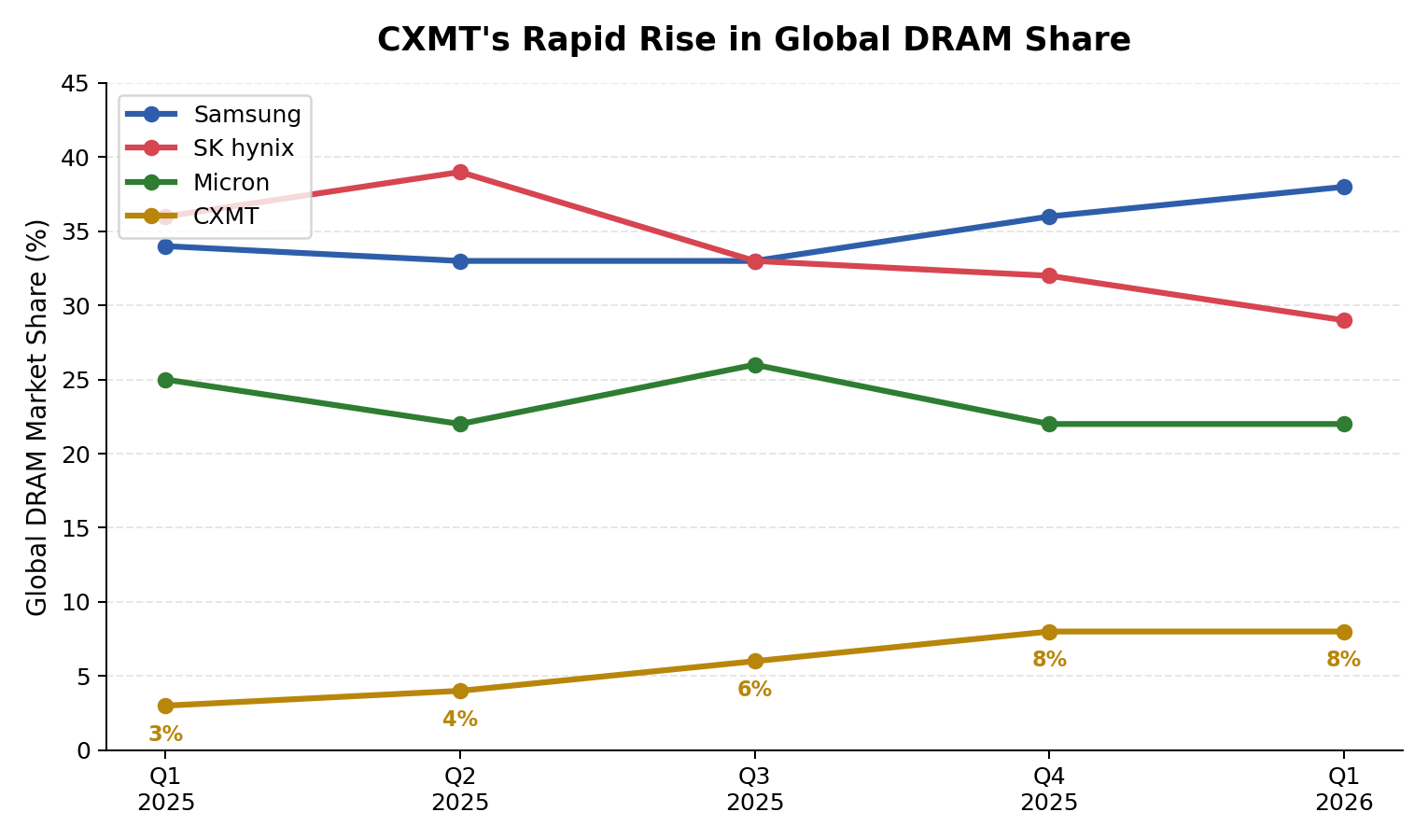
    카운터포인트리서치 집계에 따르면 CXMT의 글로벌 D램 시장 점유율은 2025년 1분기 3%에서 2026년 1분기 8%로, 1년 만에 두 배 이상 뛰었다. 같은 기간 1위 삼성전자는 34%→38%, 2위 SK하이닉스는 36%→29%, 3위 마이크론은 25%→22%를 기록했다. 2026년 1분기 CXMT의 매출은 전년 동기 대비 700% 넘게 폭증했는데, 이는 AI 데이터센터 투자 확대로 글로벌 D램 시장 자체가 사상 최대치(970억 달러, 전분기 대비 +80%)를 기록한 훈풍을 그대로 올라탄 결과다.

    생산능력도 2년 사이 2배로 늘었다(월 14만 장→29만 장). CXMT 매출 구조를 보면 투자설명서 기준 모바일용 LPDDR 제품이 66.4%, DDR 제품이 31.9%를 차지해, 사실상 매출 대부분이 범용 D램에서 나오고 있다. 흥미로운 지점은 CXMT가 과거 예상과 달리 ‘저가 물량 공세’를 펼치지 않고 있다는 점이다. 애플이 CXMT의 DDR5 테스트에 나섰는데, 가격 자체는 삼성전자·SK하이닉스와 비슷한 수준으로 알려졌다. AI발 메모리 슈퍼사이클 속에서 굳이 싸게 팔 이유가 없어진 셈이다.

    이번 상장, 얼마나 큰 규모였나

    7월 27일 상하이 커촹반 상장 당시 공모가는 8.66위안, 기관 수요예측 경쟁률은 462.9대 1을 기록했다. 초과배정옵션까지 행사되면서 조달 금액은 최대 666억 위안(약 14조 5,000억~14조 7,000억 원)까지 늘어났는데, 이는 2010년 중국농업은행 기업공개(IPO) 이후 역대 두 번째로 큰 규모다. 공모가 기준 시가총액은 5,791억 위안(약 126조 원)이었지만, 상장 첫날 465~476% 폭등하며 종가 기준 시가총액이 3조 2,800억 위안(약 712조 원, 484억 6,000만 달러)까지 불어났다. 이는 같은 날 미국 인텔의 시가총액을 넘어서는 규모이자, 그동안 중국 본토 시가총액 1위였던 중국공상은행마저 뛰어넘는 수준이다.

    HBM 진출 계획과 남은 기술 격차

    CXMT는 조달한 자금을 발판으로 AI 메모리 시장까지 넘보고 있다. 상하이에 허페이 본사 대비 2~3배 규모의 신공장을 짓고 있으며, 이미 확보한 상하이 공장 생산능력의 약 20%(월 6만 장 웨이퍼)를 HBM3 생산으로 전환 중이다. HBM3E 이후 제품으로의 확장 가능성도 검토되고 있다. 신규 장비 설치는 2026년 하반기 완료 예정이며, 2027년부터 서버·PC·자동차용 D램 본격 양산에 들어갈 계획이다.

    다만 업계는 HBM 시장에서 CXMT와 글로벌 선도기업(삼성전자·SK하이닉스) 간에는 여전히 3년 이상의 기술격차가 존재한다고 본다. 그래서 당장 HBM 시장에 미치는 파급력은 제한적이라는 게 중론이다. 오히려 진짜 변수는 범용 D램 쪽이다. 삼성전자·SK하이닉스·마이크론 등 메모리 3사가 HBM과 AI용 고부가가치 제품 비중을 늘리는 사이, CXMT가 상대적으로 소외된 범용 D램 수요를 빠르게 흡수하고 있다는 평가다.

    투자자가 알아둬야 할 유의사항

    • HBM과 범용 D램을 분리해서 판단할 것: CXMT의 진짜 위협은 아직 AI 메모리(HBM)가 아니라 범용 D램 시장이다. 삼성전자·SK하이닉스의 핵심 성장 동력인 HBM 경쟁력이 당장 훼손된 것은 아니라는 점을 구분해야 한다.
    • ‘무감산’ 전략이 향후 공급과잉으로 이어질 수 있다: 과거 CXMT 지분 확대 시기 국제 D램 가격이 35% 가까이 폭락하며 대만 레거시 업체(난야·윈본드·PSMC)의 매출이 역성장한 전례가 있다. 현재는 AI 슈퍼사이클로 공급이 부족한 상황이지만, 이 초과수요 국면이 끝나는 시점에 CXMT의 생산능력 확대가 고스란히 공급과잉 압력으로 되돌아올 수 있다.
    • 기술 유출 리스크는 현재진행형 이슈다: CXMT는 과거 한국 기업 출신 인력을 통한 기술 유출 혐의로 논란이 된 바 있고, 2026년에도 마이크론·샌디스크 등 해외 인력 영입을 계속 확대하고 있다. 이는 CXMT의 기술 추격 속도를 예상보다 앞당길 수 있는 변수다.
    • 상장 첫날의 폭등은 과열일 수 있다: 중국 반도체주는 상장 첫날 폭등하는 경향이 뚜렷하다(GPU 업체 메타엑스도 693% 급등한 전례가 있다). 상장 직후의 시가총액이 회사의 적정 가치를 반영한다고 보기는 어렵다는 점에 유의해야 한다.
    • 노무라의 전망치는 어디까지나 전망이다: 아래 소개할 노무라증권의 시장점유율 확대 전망은 여러 시나리오 가운데 하나이며, 실제 결과는 미국의 대중 반도체 장비 수출 규제 강도, 중국 내수 경기 등 변수에 따라 크게 달라질 수 있다.

    전문가 의견 정리

    • 노무라증권: CXMT의 메모리 출하량이 2030년까지 매년 40~45%씩 성장하고, D램 글로벌 시장점유율도 현재 약 10%에서 2028년 말 18%까지 확대될 수 있다고 전망했다.
    • 김양팽 산업연구원 전문연구위원: 첨단 메모리 분야의 기술격차는 당분간 유지될 수밖에 없다고 봤다. 중국이 첨단 반도체 장비 도입에 여전히 어려움을 겪고 있기 때문이라는 설명이다. 다만 현재의 격차만으로 중국의 추격 가능성을 과소평가해서는 안 된다고 강조했다.
    • 업계 관계자(글로벌 D램 공급망 관련): 중국 기업들이 국가 보조금과 거대한 내수 AI 서버 수요를 기반으로 대량생산 전략을 구사하고 있다고 진단했다. 한국 기업들이 HBM에 집중하는 사이 구형(레거시) 시장에서 점유율 균열이 발생하고 있다는 지적도 나온다.
    • 업계 분석(가격 전략 관련): 과거 시장에서는 중국 업체들이 대규모 증설 이후 저가 물량 공세를 펼칠 것이라는 우려가 지배적이었지만, AI발 메모리 슈퍼사이클로 시장 환경이 급변하면서 CXMT가 삼성전자·SK하이닉스와 비슷한 가격 수준을 유지하고 있다는 분석도 나온다. 다만 이는 현재의 초과수요 국면에서만 성립하는 전략일 수 있다는 점에서, 수요가 둔화될 경우 다시 저가 공세로 전환할 가능성을 배제할 수 없다.

    종합하면 CXMT는 설립 10년 만에 글로벌 D램 시장 4위, 시가총액 기준 세계적 반도체 기업 반열에 오른 것이 사실이다. 다만 AI 메모리(HBM) 분야에서는 여전히 3년 이상의 기술격차가 존재해 삼성전자·SK하이닉스의 핵심 경쟁력을 당장 위협하는 수준은 아니다. 진짜 지켜봐야 할 변수는 범용 D램 시장에서의 생산능력 확장 속도와, AI 슈퍼사이클이 끝난 이후에도 지금의 ‘고가 전략’을 유지할지 여부다.

    참조 사이트

    • 위키백과 — “창신 메모리 테크놀로지” (ko.wikipedia.org)
    • 나무위키 — “CXMT” (namu.wiki)
    • 머니투데이 — “‘중국의 삼성’ 꿈꾸는 창신메모리[차이나는 중국]” (mt.co.kr)
    • 나무증권 블로그 — “중국 DRAM 1위 CXMT(창신메모리)는 어떤 기업일까?” (mynamuhbegin.com)
    • 카운터포인트리서치 — “전세계 D램 및 HBM 시장 점유율: 분기별 데이터” (korea.counterpointresearch.com)
    • 카운터포인트리서치 — “전세계 DRAM 매출 80% 폭등…삼성 1위·CXMT 급성장” (korea.counterpointresearch.com)
    • 한국경제 — “D램 무섭게 팔아치웠다…매출 700% 폭증한 중국 기업” (hankyung.com)
    • 파이낸셜뉴스 — “中반도체 첨병 CXMT, 삼전닉스 위협 ‘D램 굴기’로 떠오르다” (fnnews.com)
    • 테크월드 — “1분기 D램 시장, 삼성전자 1위 유지 속 CXMT 급부상…시장 판도 변화 조짐” (epnc.co.kr)
  • 국제유가는 오히려 급락한 날, 반도체 개별 이슈 하나로 시장 전체가 흔들렸다

    오늘(28일) 코스피가 장중 9.57%까지 폭락하며 올해 들어 8번째 서킷브레이커가 발동됐다. 흥미로운 건 오늘 국제유가는 오히려 급락했다는 점이다(브렌트유 -8.7%). 최근 몇 주간 시장을 흔들었던 중동 리스크·고유가 요인이 없었는데도 이 정도 낙폭이 나왔다는 건, 그만큼 이번 충격의 진원지가 순수하게 반도체 업종 내부에 있다는 뜻이다. 바로 중국 최대 D램 업체 창신메모리(CXMT)의 상하이 증시 상장 흥행이다. 오늘은 이 급락의 타임라인과, 실제로 얼마나 위협적인 뉴스인지를 냉정하게 짚어본다.

    사이드카에서 서킷브레이커까지, 30분 만에 벌어진 일

    코스피는 전 거래일보다 355.48포인트(5.26%) 내린 6,400.27로 개장했다. 개장과 동시에 코스피200 선물가격이 5% 이상 하락하면서 오전 9시 6분 매도 사이드카가 발동됐고, 코스닥에서도 9시 14분 별도의 매도 사이드카가 발동됐다. 그러나 낙폭은 좀처럼 줄어들지 않았다. 오전 9시 30분 -7.29%(6,263.53)까지 밀린 데 이어, 결국 오전 10시 13분 43초 전 거래일 대비 8.04%(543.49포인트) 급락한 6,212.26을 기록하며 유가증권시장 전체의 매매를 20분간 정지시키는 서킷브레이커가 발동됐다. 올해 들어 벌써 8번째 서킷브레이커다. 매매 재개 이후에도 낙폭은 더 커져 장중 한때 6,109.51(-9.57%)까지 밀렸다.

    수급을 보면 외국인 매도세가 시간이 갈수록 거세졌다. 개장 초반 1조 원대였던 외국인 순매도는 오전 중 1조 7,154억 원, 이어 2조 628억 원까지 불어났다. 기관도 500억~1,500억 원대 매도 우위를 이어가며 하락에 가세했다. 반면 개인은 저가 매수에 나서며 1조 6,744억 원에서 2조 71억 원까지 순매수 규모를 키웠다. 삼성전자는 9~11%대, SK하이닉스는 11~13%대까지 밀리며 이달 최저가 수준으로 내려앉았다. 시가총액 상위 14개 종목 가운데 삼성바이오로직스를 제외한 전 종목이 하락했다. 변동성 지표인 VKOSPI(코스피200 변동성지수)도 7거래일 만에 반등해 80선을 넘어섰다(80.46, +3.75%).

    진앙지: 창신메모리, 상장 첫날 인텔 시총 넘어섰다

    충격의 시작은 전날인 27일 중국 상하이증권거래소 기술특례시장(과창판)에 상장한 창신메모리테크놀로지(CXMT)였다. 공모가 대비 최대 476% 폭등하며 장중 55.03위안까지 치솟았고, 종가 기준 시가총액은 3조 2,800억 위안(약 712조 원, 484억 6,000만 달러)을 기록했다. 이는 지난 24일(현지시간) 뉴욕증시 종가 기준 인텔의 시가총액(469억 3,000만 달러)을 넘어서는 규모이자, 그동안 중국 본토 시가총액 1위였던 중국공상은행(2조 7,600억 위안)마저 훌쩍 뛰어넘는 수준이다. 상장 하루 만에 중국 반도체 자립의 상징으로 떠오른 셈이다. 이 여파가 27일(현지시간) 미국 증시로 먼저 번져 필라델피아 반도체지수가 2.2% 하락 마감했고, 샌디스크(-11.02%)·웨스턴디지털(-4.21%)·씨게이트(-4.07%)·마이크론(-2.25%)이 동반 하락했으며 SK하이닉스 ADR도 7.47% 급락했다. 이 미국발 낙폭이 오늘 국내 개장과 함께 그대로 반영된 것이다.

    그런데, 정말 이 정도로 위협적인가?

    시장이 급락한 만큼, 실제 위협 수준을 냉정하게 따져볼 필요가 있다. 결론부터 말하면 CXMT의 현재 주력 제품은 모바일용 LPDDR과 일반 PC·서버용 범용 D램이다. AI 붐의 핵심인 고대역폭메모리(HBM)는 여전히 수율 문제로 양산 이전 단계에 머물러 있다. 기술 로드맵으로 보면 CXMT는 이제 HBM3E(5세대) 양산을 내년 이후에나 시작할 것으로 업계는 보고 있는데, 삼성전자와 SK하이닉스는 이미 6세대 HBM4를 엔비디아 등 주요 고객사에 공급 중이고 7세대 HBM4E 샘플까지 출하한 상태다. 최소 두 세대 이상의 기술 격차가 유지되고 있는 셈이다.

    즉, 오늘 시장이 반응한 진짜 공포는 ‘AI 메모리 시장에서 중국이 당장 한국을 추월한다’는 것이 아니라, ‘CXMT가 이번 대규모 자금 조달(약 14조 원)을 발판으로 범용 D램 생산능력을 크게 늘려 글로벌 공급과잉과 가격 경쟁을 유발할 수 있다’는 우려에 가깝다. 실제로 시장의 관심은 CXMT의 현재 실적보다 상장 이후 증설과 기술개발 속도에 쏠려 있다.

    투자자 유의사항 및 전문가 의견 정리

    ⚠️ 투자자가 유의해야 할 점

    • 서킷브레이커 발동 자체가 패닉의 신호일 수 있다: 시장 냉각 장치가 발동됐음에도 매매 재개 후 낙폭이 오히려 확대된 점은 투자심리가 극도로 위축돼 있다는 뜻이다. 이런 국면에서 공포에 휩쓸린 투매는 오히려 손실을 키울 수 있다.
    • HBM과 범용 D램을 구분해서 볼 것: 오늘 급락의 근거가 된 것은 AI 메모리(HBM)가 아니라 범용 D램 공급과잉 우려다. 삼성전자·SK하이닉스의 핵심 성장 동력인 HBM 경쟁력 자체가 훼손된 것은 아니라는 점을 구분해서 판단할 필요가 있다.
    • 내일(29일) SK하이닉스 실적이 진짜 분수령: 오늘의 공포가 과도했는지 여부는 내일 실적 발표에서 회사 측이 내놓을 HBM 수요·가격 전망에 달려 있다. 실적 발표 전날 급락한 만큼, 발표 내용에 따라 변동성이 한 번 더 커질 수 있다.
    • 장기적 경쟁 구도 변화는 계속 지켜봐야: 전문가들은 현재의 기술격차만 보고 중국의 추격 가능성을 과소평가해서는 안 된다고 짚는다. 중국 정부의 지원과 거대한 내수, 대규모 자본이 결합되면 중장기적으로는 실질적 경쟁자로 성장할 수 있다는 시각도 있다.

    📌 전문가 의견

    • 김양팽 산업연구원 전문연구위원: 첨단 메모리 분야에서 기술격차는 당분간 존재할 수밖에 없는데, 이는 중국이 첨단 반도체 장비 도입에 어려움을 겪고 있기 때문이라고 설명했다. 다만 현재의 격차만으로 중국의 추격 가능성을 과소평가해서는 안 된다고 강조했다.
    • 업계 관계자(글로벌 D램 공급망 관련): 중국 제조사들이 저가 전략으로 우선 시장 규모를 확보한 뒤 고부가 제품으로 이동하는 전략을 구사하고 있다고 진단하며, 한국 기업들이 HBM 분야 선두를 유지하더라도 범용 D램 시장을 소홀히 할 경우 장기적으로 수익성에 부담이 될 수 있다고 지적했다.
    • 시장 해설(투자은행 리서치): 이번 주 예정된 SK하이닉스 실적 발표와 미국 빅테크(M7) 실적, FOMC 금리 결정이 향후 국내 증시 방향을 가를 핵심 변수가 될 것으로 전망했다. 이달 초 삼성전자, 지난주 알파벳 모두 호실적을 냈음에도 오히려 주가가 급락했던 경험이 이번 주 실적 발표를 향한 경계심리를 더욱 자극하고 있다는 분석도 나온다.

    종합하면 오늘의 폭락은 유가나 금리 같은 거시 변수가 아니라, 중국 반도체 굴기라는 산업 내부 이슈 하나로 촉발된 드문 사례다. 다만 실제 기술격차를 냉정히 뜯어보면 이번 충격은 HBM 경쟁력 훼손보다는 범용 D램 공급과잉 우려에 가깝다. 내일 SK하이닉스 실적 발표에서 이 공포가 과도했는지, 아니면 정당한 경계였는지가 가려질 전망이다.

    참조 사이트

    • 파이낸셜뉴스 — “창신發 반도체 쇼크에 증시 ‘패닉’…코스피 8% 급락 ‘서킷브레이커’” (fnnews.com)
    • 한국일보 — “코스피 8% 급락에 올해 8번째 서킷브레이커…6200선 추락” (hankookilbo.com)
    • 한국경제 — “中 창신메모리 쇼크…코스피 8% 급락 서킷브레이커” (hankyung.com)
    • 경향신문 — “[속보]코스피, 8% 폭락에 서킷브레이커…올 들어 8번째” (khan.co.kr)
    • 글로벌이코노믹 — “CXMT, 상장 첫날 주가 466% 폭등… ‘한국 메모리 양강 위협’” (g-enews.com)
    • 경향신문 — “‘상장 첫날 시총 712조 1위’ 중국 CXMT, 한국 반도체 업계도…” (khan.co.kr)
    • 파이낸셜뉴스 — “中반도체 첨병 CXMT, 삼전닉스 위협 ‘D램 굴기’로 떠오르다” (fnnews.com)
    • 인베스트조선 — “中 CXMT發 메모리 공급확대 우려 충격에 코스피 급락…6200선 위협” (investchosun.com)
  • A blueprint ten months in the making, targeting 520,000 visitors and a 1 trillion won economic boost

    An unfamiliar term showed up in the news today (the 27th): FANOMENON. It’s the name of a large-scale K-culture festival that the South Korean government and private industry have been developing together, with the explicit goal of creating a “Korean Coachella.” The Public Culture Exchange Committee held a press briefing today at the National Museum of Modern and Contemporary Art in Seoul’s Jongno district to formally unveil its “2027 FANOMENON” implementation plan, roughly ten months after the concept was first floated publicly. Today we break down exactly what FANOMENON is, and what timeline and economic impact it’s projecting.

    What Exactly Is FANOMENON?

    “FANOMENON” is a coined term combining “Fan” and “Phenomenon,” meaning “a phenomenon fans create.” The idea traces back to the Public Culture Exchange Committee, newly established under the Lee Jae-myung administration, which declared upon its launch last year that it aimed to build a K-pop festival surpassing the Coachella Valley Music and Arts Festival, America’s largest music festival. Culture Minister Choi Hwi-young and JYP Entertainment CCO (Chief Creative Officer/lead producer) Park Jin-young serve as co-chairs of the committee, and the event name has already been trademarked in major markets around the world.

    ItemDetails
    DatesDecember 2 (opening eve) through 12, 2027 (11 days total)
    VenuesSeoul Arena in Changdong (scheduled for completion in May 2027), KINTEX Exhibition Hall 2 in Goyang
    Core ProgrammingLarge-scale K-pop concerts + a “Fandom Awards” ceremony (awards go to fandoms, not artists)
    Projected Visitors520,000
    Projected Economic Impact1 trillion won
    Operating StructurePrivate sector (planning, operations, production, promotion, content) + government (immigration, safety management, tourism promotion, SME participation support)

    The Most Distinctive Feature: The “Fandom Awards”

    FANOMENON’s centerpiece program is a “Fandom Awards” ceremony, a departure from conventional artist-focused awards shows. The most passionate and influential fandom of the year is selected through data analysis, but the actual award is accepted by the corresponding artist or brand on the fandom’s behalf. Committee co-chair Park Jin-young described the approach as being “based on meticulously researched data.” At Seoul Arena in Changdong, a two-week run of concerts combined with the awards ceremony will feature well-known artists taking the stage in succession, while KINTEX Exhibition Hall 2 in Goyang will host music performances alongside exhibition and experience programs featuring K-culture companies across food, beauty, fashion, webtoons, film, drama, and animation. The committee is also reviewing plans, in coordination with the Seoul city government, to run related programming in major downtown areas like Gwanghwamun and City Hall.

    Projected visitor numbers and economic impact for FANOMENON 2027

    It Doesn’t End in 2027: A Roadmap Stretching to LA

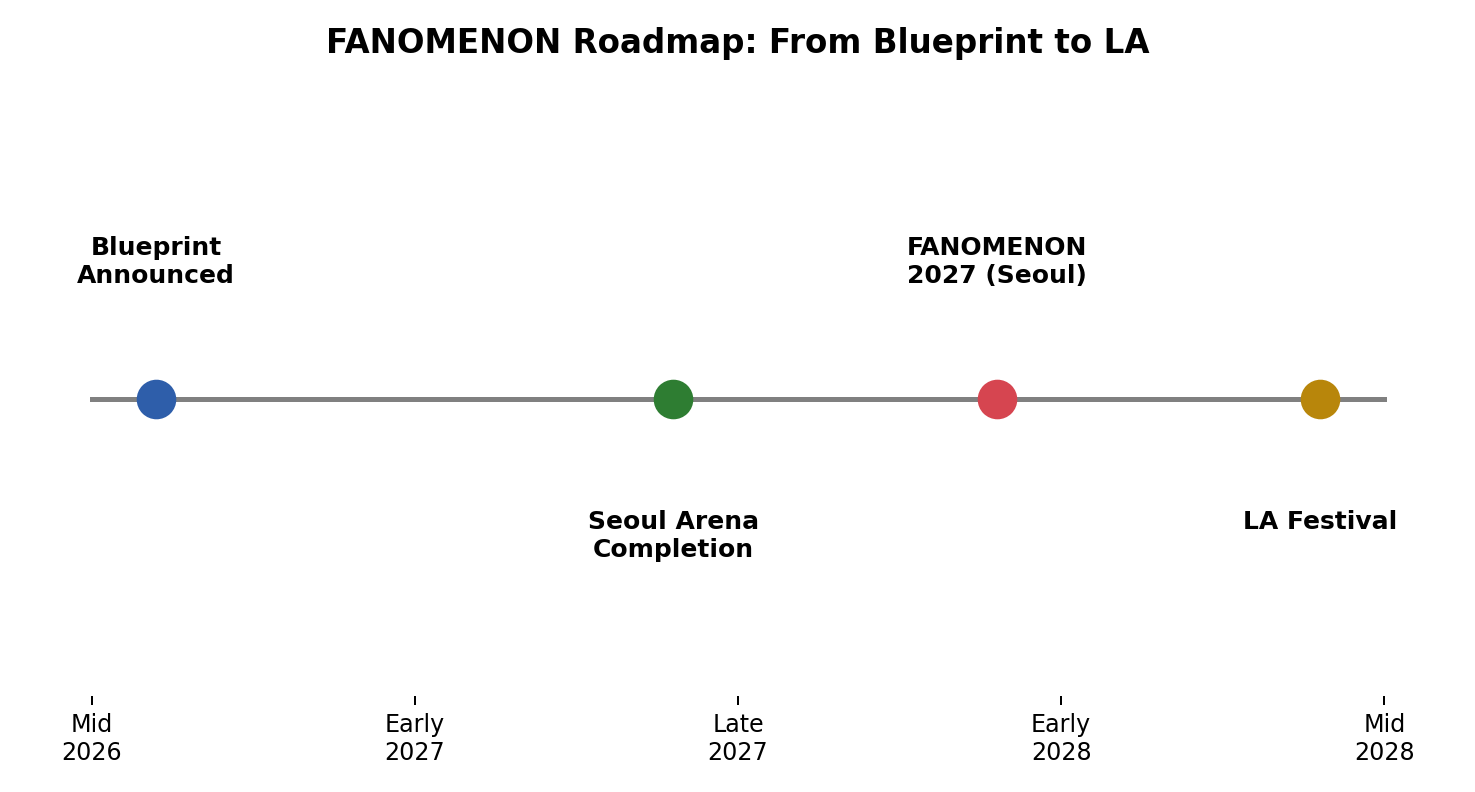
    FANOMENON’s ambitions extend well beyond its 2027 Seoul debut. Co-chair Park Jin-young laid out three broad goals: (1) holding the FANOMENON Awards ceremony in December 2027; (2) holding a FANOMENON festival in Los Angeles in May 2028; and (3) building K-culture centers in major cities around the world. In short, it’s a three-phase vision: start in Seoul, expand to the US, and eventually establish permanent infrastructure through K-culture centers.

    FANOMENON's roadmap from blueprint announcement to the LA festival

    The Unresolved Question: Budget

    The part of today’s briefing that lacked the most specificity was the budget. Asked about funding, Culture Minister Choi Hwi-young said “we’re continuing to discuss what funding sources will be used to run the event,” noting that the committee is reviewing multiple funding approaches, including government support programs and FANOMENON’s own ticket revenue. In other words, neither the specific budget size nor the split between government and private funding has been finalized. With roughly a year and four months left before the event, how concretely this funding plan takes shape will be a key variable in gauging whether it’s actually achievable.

    Watch Points and Official Statements

    ⚠️ Things Worth Watching Going Forward

    • Whether Seoul Arena stays on schedule: The event’s key venue, Seoul Arena in Changdong, is scheduled for completion in May 2027, just seven months before the December event. Any construction delay could affect the entire event timeline.
    • When the budget gets finalized: Funding plans remain under discussion. Confirming when and how much government budget is actually allocated will be necessary to assess feasibility.
    • The real gap with Coachella: Having set out to “surpass Coachella,” the event’s success will hinge on whether its lineup and ability to draw international fans can actually reach that level.
    • The scope of benefit to related industries: Ripple effects for entertainment, tourism, and retail companies tied to K-culture have been mentioned, but no concrete company-by-company benefit scenarios have been disclosed yet. It’s too early to draw investment conclusions.

    📌 Official Statements

    • Park Jin-young, co-chair of the Public Culture Exchange Committee: Said, “The picture is so beautiful that it’s a bit overwhelming and daunting, but we’re going to try,” adding that the goal is to establish South Korea as the center of the global fandom industry. He explained that the purpose is to solidify the opportunity K-culture currently has and make it as sustainable as possible.
    • Choi Hwi-young, Minister of Culture, Sports and Tourism: When asked about the budget, said the committee continues to review multiple funding approaches, including government support programs and the event’s own ticket revenue.

    In summary, FANOMENON is a multi-year project combining K-pop concerts and a fandom-focused awards show, in a privately led event backed by government support, starting with its Seoul debut in December 2027, expanding to Los Angeles in 2028, and eventually building K-culture centers worldwide. With funding still undecided and roughly 16 months remaining before the event, it will be worth watching closely how the concrete execution plan fills in over upcoming announcements.

    Sources

    • Hankyung — “Korea’s ‘K-Coachella’ FANOMENON to Run 11 Days Next December… Projected Economic Impact of 1 Trillion Won” (hankyung.com)
    • Etoday — “Park Jin-young: ‘Global Fandom Comes to Seoul in December… K-Coachella FANOMENON Expected to Generate 1 Trillion Won’” (etoday.co.kr)
    • TV Seoul — “Public Culture Exchange Committee: ‘FANOMENON to Launch Next December… Expecting 520,000 Visitors and 1 Trillion Won Impact’” (tvseoul.kr)
  • The index rebounded, but behind the scenes, retail investors made one last push just three days before new rules take effect

    The KOSPI, which plunged 5.72% last Friday, rebounded today (the 27th) to close at 6,755.75, lifted by combined buying from individual investors and institutions. Hopes around Korea-US semiconductor cooperation pushed the index higher, but foreign investors sold more than 3 trillion won worth of shares, a starkly different reaction. Behind all of this lies a specific driver: individual investors rushing in for one last round of bargain-hunting ahead of new single-stock leveraged ETF regulations set to take effect on the 31st. Today we walk through the day’s KOSPI action, along with the hidden risk retail investors are diving into with these leveraged products.

    Down to 6,557 After the Open, Then a Rebound to 6,755.75

    The KOSPI opened sharply higher, up 115.65 points (1.73%) at 6,806.27. But it gradually gave back those gains, hovering flat before turning negative in the afternoon, at one point falling as low as 6,557.39 (-1.99%). It then reversed higher again, ultimately closing up 65.13 points (0.97%) at 6,755.75. The gap between the day’s high and low reached 248.88 points, a volatile session by any measure. The KOSDAQ rose in tandem, up 16.64 points to 764.86. Trading volume on the KOSPI came in at 270.91 million shares, with turnover reaching 23.5046 trillion won.

    KOSPI's path from open to close on July 27, 2026

    The Backdrop: Korea-US Chip Cooperation, and a Divided Foreign Response

    Today’s strong open was driven by news of Korea-US semiconductor cooperation that emerged over the weekend. Coinciding with President Lee Jae-myung’s visit to the US, major companies from both countries unveiled large-scale chip cooperation plans. Samsung Electronics agreed to a five-year, $200 billion (roughly 292.6 trillion won) deal with Broadcom running through 2030, covering advanced memory supply and AI chip foundry cooperation. Samsung Electronics Chairman Lee Jae-yong also met with OpenAI CEO Sam Altman to discuss AI and semiconductor collaboration. Adding to the favorable backdrop, a lull in the US-Iran military standoff sent both oil prices and US Treasury yields lower.

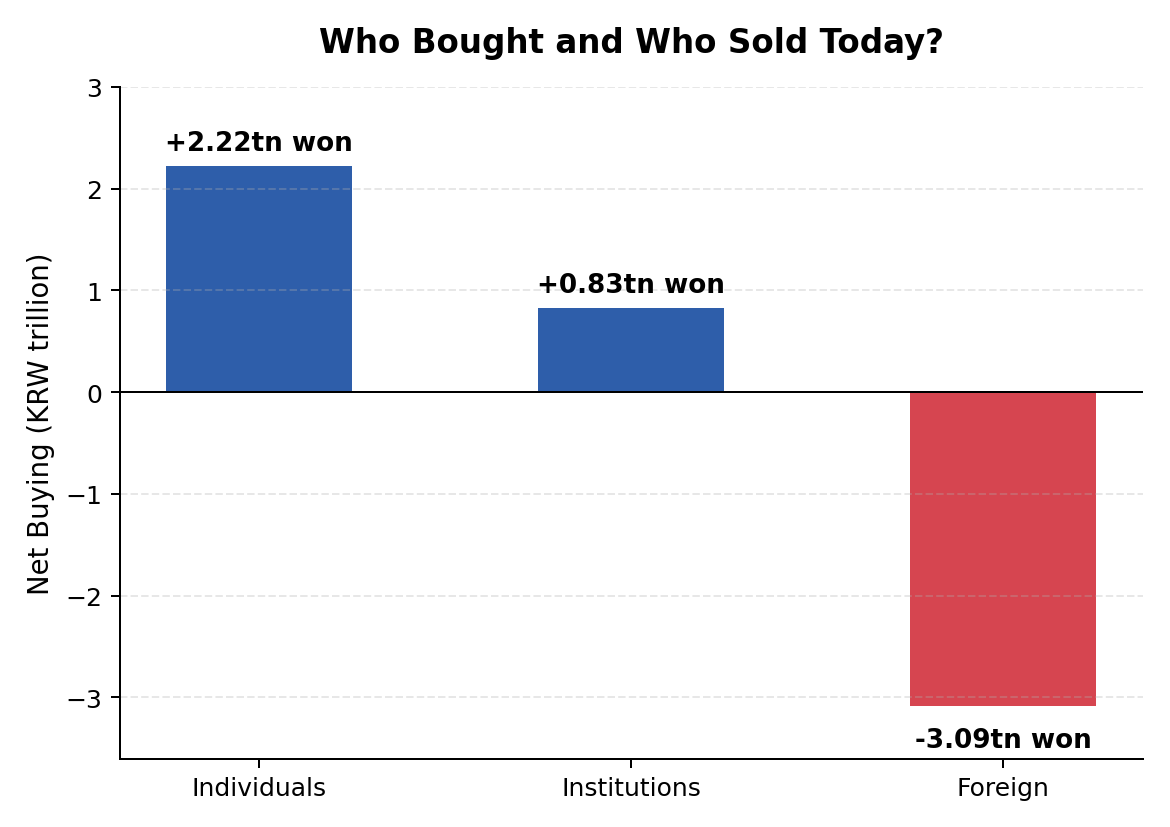
    Foreign investors, however, undercut this positive news with heavy selling. Having built up nearly 2 trillion won in net buying last week and fueling hopes of a renewed “buy Korea” trend, foreign investors flipped to net selling from the early session onward, ultimately selling a net 3.0858 trillion won. Behind this lies the fallout from a 4.3% plunge in the Philadelphia Semiconductor Index on July 24 (US time). Intel fell 7.9% despite posting better-than-expected earnings, weighed down by doubts over its ability to secure future foundry customers, while Broadcom, AMD, and Micron all declined in sympathy. In other words, AI valuation concerns around Korea’s large-cap chip names remain unresolved. Individual investors (net buying 2.2202 trillion won) and institutions (net buying 826.7 billion won) absorbed this selling and helped support the index.

    Net buying and selling by investor type on July 27, 2026

    “After the 31st, You Can’t Buy In” — Retail Investors Flock to Leveraged ETFs

    One reason individual net buying was so pronounced was a rush to get ahead of tightening regulations on single-stock leveraged ETFs. The minimum cash deposit requirement for these products, originally set to rise to 30 million won on August 5, was moved up to July 31, prompting individual investors to treat this as a “last chance to buy the dip before the rules change.” According to the Korea Exchange and Koscom, on July 24 alone (“Black Friday,” when Samsung Electronics fell 7.59% and SK hynix fell 8.34%), individual investors net bought a combined 453.8 billion won across 14 single-stock leveraged ETFs tracking the two chipmakers in a single day. That amount recovered most of the net selling (547.1 billion won) recorded over the prior three sessions (the 21st-23rd). By product, 350 billion won flowed into the seven SK hynix leveraged ETFs, and 103.8 billion won into the seven Samsung Electronics leveraged ETFs.

    But Is It Actually a Good Idea? The Hidden Trap of “Volatility Drag”

    There’s a crucial concept every investor should understand here: volatility drag. Single-stock leveraged ETFs are designed to track twice the daily return of their underlying asset, which means that as a stock swings up and down repeatedly, the ETF’s principal erodes steadily, a structural feature of how these products work. According to the Korea Exchange, from the leveraged ETFs’ listing in late May through July 15, SK hynix shares fell 7.18%, but the average return on ETFs tracking it was -34.06%, roughly five times the loss of the underlying stock. Samsung Electronics showed a similar pattern: shares fell 8.96% over the same period, while the seven related leveraged ETFs averaged a -30.66% return.

    Comparison of underlying stock returns versus leveraged ETF returns for SK hynix and Samsung Electronics
    StockUnderlying Return (Late May-Jul 15)Avg. Leveraged ETF ReturnLoss Multiple
    SK hynix-7.18%-34.06%~5x
    Samsung Electronics-8.96%-30.66%~3.4x

    In other words, even if a stock eventually recovers, repeated ups and downs along the way can leave leveraged ETF holders with far steeper losses. This volatility drag effect becomes especially pronounced in a rollercoaster market like the current one, where the index can plunge more than 5% one day and rebound the next.

    Investor Takeaways and Expert Views

    ⚠️ Things Investors Should Watch

    • Be wary of “last chance before the rules change” thinking: The fact that regulators are tightening rules is itself a signal that a product carries significant risk. The urgency of “buy now or miss out” can cloud sound judgment.
    • Leveraged ETFs aren’t built for long-term holding: Because of volatility drag, holding these products through volatile stretches can produce far steeper losses than the underlying stock itself. As a general rule, they’re best used only briefly, for short-term directional bets.
    • Note the gap between foreign and domestic sentiment: Foreign investors sold more than 3 trillion won today despite the positive news. That’s a sign that foreign and domestic investors still see Korean chip valuations quite differently.
    • This week’s earnings are the next key test: Samsung Electronics’ and SK hynix’s second-quarter results and second-half outlooks will be a key gauge of whether the AI investment cycle is holding up. With major US Big Tech earnings and the FOMC decision also landing this week, volatility could pick up further.

    📌 What Experts Are Saying

    • Financial industry observers: Some analysts argue that this month’s sharp KOSPI declines owe less to any deterioration in the semiconductor industry itself and more to elevated market expectations, deleveraging among leading stocks, and rebalancing flows tied to single-stock leveraged ETFs, all compounding at once. Indeed, last week (July 20-24) the KOSPI rose 4.1% while the KOSDAQ fell 0.2%, a clear divergence between large-cap and smaller names.
    • Analysis based on Korea Exchange data: Given that volatility drag on single-stock leveraged ETFs has run three to five times the underlying stock’s decline, the prevailing view is that tighter regulation was a necessary step for investor protection.

    Taken together, today’s session reflected a tight tug-of-war between positive news on Korea-US chip cooperation and lingering AI valuation concerns. Retail buying ahead of the leveraged ETF rule change helped prop up the index, but it’s worth remembering that the volatility drag risk embedded in these products remains substantial. This week’s Samsung Electronics and SK hynix earnings, along with US Big Tech results and the FOMC decision, will likely determine which side of this delicate balance wins out.

    Sources

    • Money Today — “KOSPI Rebounds to Close at 6,755.75… Individuals and Institutions in ‘Combined Buying’” (mt.co.kr)
    • Hankyung — “KOSPI Fluctuates Throughout the Session, Closes Up 0.97% at 6,755.75” (hankyung.com)
    • WikiTree — “KOSPI Closes at 6,755.75… Which Sector Fell Alone as Large Caps Rose?” (wikitree.co.kr)
    • Getnews — “KOSPI Fluctuates, Closes Up 0.97%… Recovers 6,700 Level” (getnews.co.kr)
    • Namdo Ilbo — “[Market Recap] ‘Rollercoaster’ Semiconductor Stocks… Samsung Electronics, SK hynix Close Higher” (namdonews.com)
    • Financial News — “‘You Can’t Buy After the 31st’… Retail Investors Bet Big Amid Samsung Electronics, SK hynix Plunge” (fnnews.com)
    • EBN News Center — “SK hynix Down 7%, Its Leverage ETF Down 34%… Retail Investors Caught in ‘Volatility Drag’ Trap” (ebn.co.kr)
    • Newspim — “[Market Close] KOSPI Recovers 6,750 Level… Up 1% on Institutional, Individual Buying” (newspim.com)
  • A month into the program, early enrollees are already reporting denials and confusing eligibility rules

    Since July 1, eligible Medicare beneficiaries have been able to access some of the most talked-about weight-loss drugs in the country for a flat $50 a month, down from list prices that can top $1,300. The program is called the Medicare GLP-1 Bridge, and it’s now a full month into its run. It’s a genuinely significant shift for older Americans living with obesity, but it’s also a temporary, narrowly scoped demonstration with real friction already showing up. Here’s what it actually covers, who qualifies, and what’s tripping people up so far.

    What the Bridge Program Actually Covers

    The Medicare GLP-1 Bridge is a short-term demonstration run by the Centers for Medicare & Medicaid Services (CMS), running from July 1, 2026 through December 31, 2027. Eligible beneficiaries enrolled in Medicare Part D drug plans pay a flat $50 monthly copay for a covered supply of Wegovy (semaglutide, injection or tablet), Zepbound (tirzepatide, KwikPen only), or Foundayo (tablet). That $50 figure doesn’t count toward your plan’s deductible or annual out-of-pocket limit, and it stays fixed regardless of your income or which stage of Part D coverage you’re in. Notably, the single-dose Zepbound pen and Zepbound vials are not covered under the program, only the KwikPen version.

    The gap between the Bridge copay and full retail pricing is enormous. Wegovy’s list price runs around $1,350 a month, while Zepbound’s list price is roughly $1,080 to $1,270 depending on the source. Compared to that, a $50 flat copay is a dramatic reduction, which is exactly why the program has drawn so much attention since its announcement in May.

    One Important Catch: Ozempic Isn’t Included

    A detail that trips up a lot of people: Ozempic and Wegovy share the exact same active ingredient, semaglutide, made by the same manufacturer, Novo Nordisk. But Ozempic is approved for Type 2 diabetes management, not weight loss, and the Bridge program only covers drugs with an FDA-approved weight-loss indication. If your doctor prescribes Ozempic off-label for weight loss, it isn’t covered under the Bridge, regardless of eligibility otherwise. Wegovy, by contrast, is FDA-approved both for chronic weight management and for reducing cardiovascular risk in adults with established heart disease who are overweight or obese, which is why it made the covered list.

    Why This Program Exists, and Why It’s Temporary

    CMS originally designed the Bridge as a six-month transition toward a longer-term program called BALANCE (Better Approaches to Lifestyle and Nutrition for Comprehensive hEalth), which was set to launch in January 2027 and shift responsibility for covering these drugs onto private insurers running Part D plans. That plan hit a wall: insurers including CVS and UnitedHealthcare declined to participate voluntarily, citing concerns about the program’s structure and costs. In response, CMS extended the Bridge through the end of 2027 and says it plans to use data from the demonstration to build a case for broader insurer participation in BALANCE down the line. A CMS official told reporters the agency will “carefully track participation and outcomes” to inform smarter policy going forward.

    Where Enrollees Are Already Running Into Trouble

    A month in, real-world friction is already surfacing. On patient forums, enrollees have described prior-authorization denials despite appearing to meet the program’s stated criteria, confusion over how comorbidities like prediabetes or sleep apnea factor into eligibility, and cases where prescriptions were submitted to a regular Part D plan instead of being processed correctly under the Bridge. One recurring complaint: the eligibility page lists a BMI of 30+ with prediabetes as qualifying, but some prescribers report that prediabetes isn’t listed as an eligible comorbidity in their own guidance documents, a mismatch that has led to unexpected denials for people who believed they qualified.

    Reader Takeaways and What Experts Are Saying

    ⚠️ Things to Keep in Mind

    • This is a demonstration, not a permanent benefit: The Bridge program is scheduled to run only through December 31, 2027. Whether coverage continues afterward depends on how BALANCE negotiations with private insurers play out, so it’s not something to build long-term financial plans around just yet.
    • Weight regain after stopping is a well-documented risk: One 2022 study found that people who stopped taking Wegovy regained roughly two-thirds of their prior weight loss within a year. Since the Bridge program’s future beyond 2027 is uncertain, it’s worth discussing an exit or maintenance plan with your doctor now, rather than after coverage potentially changes.
    • Cost-assistance programs can’t be combined with the $50 copay: Programs like Extra Help cannot be layered on top of the Bridge copay, and the $50 amount doesn’t change based on income or which Part D coverage stage you’re in. Double-check with your plan before assuming additional savings apply.
    • Confirm your prescription is being routed correctly: Some enrollees have had prescriptions mistakenly submitted through their regular Part D benefit rather than the Bridge program. If your claim is denied, it’s worth confirming with your pharmacy and plan that it was processed under the correct program before assuming you’re ineligible.

    📌 What Officials and Experts Are Saying

    • Jamey Millar, EVP of US Operations, Novo Nordisk: Called obesity “a serious, common chronic disease facing older Americans,” and noted that Wegovy’s cardiovascular risk-reduction benefit is particularly relevant for seniors who carry a high burden of both obesity and heart disease.
    • CMS officials: Say the agency plans to track participation and health outcomes closely during the Bridge period specifically to build the evidence base needed to bring reluctant private insurers into the longer-term BALANCE model.
    • Dr. Peminda Cabandugama, endocrinologist, Cleveland Clinic: Has noted more broadly that GLP-1 drug costs have “come down significantly” over the past year across various access channels, though list prices for standard retail fills remain well above $1,000 a month absent a savings program like the Bridge.

    Taken together, the Medicare GLP-1 Bridge is a real and meaningful cost reduction for the Medicare beneficiaries who qualify, but it’s a pilot program with a hard end date, uneven early execution, and an uncertain path to becoming permanent. If you’re on Medicare and considering the program, the practical next step is a direct conversation with your prescriber and Part D plan to confirm your specific eligibility, rather than assuming the general criteria will apply cleanly to your situation.

    Sources

    • Centers for Medicare & Medicaid Services — “Medicare GLP-1 Bridge” (cms.gov)
    • CMS Newsroom — “Coming Soon: CMS to Provide $50 Monthly Access to GLP-1 Medications for Medicare Beneficiaries” (cms.gov)
    • Medicare Rights Center — “GLP-1 Weight-Loss Drug Demonstration Begins July 2026” (medicarerights.org)
    • CNBC — “Medicare obesity drug GLP-1 coverage starting July 1” (cnbc.com)
    • PR Newswire — “Wegovy Access Expanded for Medicare Beneficiaries Living with Obesity Through the Medicare GLP-1 Bridge” (prnewswire.com)
    • GoodRx — “Zepbound vs. Wegovy: Differences Between Weight-Loss Medications” (goodrx.com)
  • 공론화 10개월 만에 나온 청사진, 목표는 예상 방문객 52만 명·경제효과 1조 원

    오늘(27일) 뉴스에 ‘패노메논’이라는 낯선 용어가 등장했다. 정부와 민간이 함께 ‘한국판 코첼라’를 만들겠다며 추진해온 대형 K컬처 축제의 이름이다. 대중문화교류위원회가 이날 서울 종로구 국립현대미술관에서 기자간담회를 열고 ‘2027 패노메논(FANOMENON)’ 추진계획을 공식 발표했다. 처음 공론화된 지 약 10개월 만에 나온 구체적인 청사진이다. 오늘은 패노메논이 정확히 무엇이고, 어떤 일정과 경제적 파급력을 예고하고 있는지 정리해본다.

    패노메논이 뭔가요?

    ‘패노메논(FANOMENON)’은 팬(Fan)과 현상을 뜻하는 페노메논(Phenomenon)을 결합한 신조어로, ‘팬들이 일으키는 현상’이라는 뜻이다. 이재명 정부 들어 신설된 대중문화교류위원회(대중위)가 지난해 출범하며 미국 최대 음악 축제인 ‘코첼라 밸리 뮤직 앤드 아츠 페스티벌’을 뛰어넘는 K팝 페스티벌을 만들겠다고 선언한 데서 시작됐다. 최휘영 문화체육관광부 장관과 박진영 JYP엔터테인먼트 CCO(대표 프로듀서)가 공동위원장을 맡고 있으며, 행사명은 이미 전 세계 주요 시장에 상표 등록까지 마쳤다.

    항목내용
    일정2027년 12월 2일(전야제)~12일(총 11일간)
    장소창동 서울아레나(2027년 5월 완공 예정), 고양 킨텍스 제2전시장
    핵심 프로그램대규모 K팝 콘서트 + ‘팬덤 시상식'(아티스트가 아닌 팬덤에게 상을 주는 방식)
    예상 방문객52만 명
    예상 경제효과1조 원
    운영 구조민간(기획·운영·연출·홍보·콘텐츠) + 정부(출입국·안전관리·관광 활성화·중소기업 참여 지원)

    가장 독특한 지점: ‘팬덤 시상식’

    패노메논의 핵심 프로그램은 기존의 아티스트 중심 시상식과는 결이 다른 ‘팬덤 시상식’이다. 한 해 동안 가장 뜨거운 열정과 영향력을 보여준 팬덤을 데이터 분석을 통해 선정하고, 정작 상은 해당 아티스트나 브랜드가 팬들을 대신해 받는 방식이다. 박진영 위원장은 이 방식이 “치밀하게 조사한 데이터를 기반으로 한다”고 소개했다. 창동 서울아레나에서는 2주에 걸쳐 유명 가수들이 차례로 무대에 오르는 콘서트와 시상식이 결합된 무대가 펼쳐지고, 고양 킨텍스 제2전시장에서는 음악 공연과 함께 푸드·뷰티·패션·웹툰·영화·드라마·애니메이션 등 다양한 K컬처 기업들이 참여하는 전시·체험 행사가 진행된다. 위원회는 서울시와 협의해 광화문·시청 등 도심 주요 공간에서도 연계 프로그램을 마련하는 방안을 검토하고 있다.

    2027년 한 번으로 끝나지 않는다: LA까지 이어지는 로드맵

    패노메논은 2027년 서울 개최를 시작으로 훨씬 더 큰 그림을 그리고 있다. 박진영 위원장이 밝힌 목표는 크게 세 가지다. ①2027년 12월 패노메논 어워즈 시상식 개최 ②2028년 5월 미국 로스앤젤레스(LA)에서 패노메논 페스티벌 개최 ③전 세계 주요 도시에 K컬처 센터 건립. 즉 서울에서 시작해 미국 현지로 무대를 넓히고, 이후 상설 인프라(K컬처 센터)까지 구축하겠다는 3단계 구상이다.

    아직 풀리지 않은 숙제: 예산

    이날 간담회에서 가장 구체성이 떨어졌던 부분은 예산이었다. 최휘영 문화체육관광부 장관은 예산과 관련해 “어떤 재원으로 행사를 추진할지 계속 협의하고 있다”며 정부 지원 사업과 패노메논 자체 티켓 수입 등 여러 재원 조달 방안을 검토 중이라고 밝혔다. 아직 구체적인 예산 규모나 정부-민간 분담 비율이 확정되지 않았다는 뜻이다. 행사 개최까지 1년 4개월 남은 시점에서, 이 재원 조달 계획이 얼마나 구체화되는지가 실행 가능성을 가늠하는 핵심 변수가 될 전망이다.

    관전 포인트 및 관계자 발언 정리

    ⚠️ 앞으로 지켜봐야 할 점

    • 서울아레나 완공 일정 준수 여부: 행사의 핵심 장소인 창동 서울아레나가 2027년 5월 완공 예정인데, 행사는 그해 12월이다. 완공이 지연되면 행사 전체 일정에도 영향을 줄 수 있다.
    • 예산 확정 시점: 재원 조달 방안이 아직 협의 중인 단계다. 정부 예산이 실제로 편성되는 시점과 규모를 확인해야 실행 가능성을 판단할 수 있다.
    • 코첼라와의 실질적 격차: ‘코첼라를 뛰어넘겠다’는 목표를 내세운 만큼, 라인업 확보력과 해외 팬 유치 규모가 실제로 코첼라급에 도달할 수 있을지가 성패를 가를 것이다.
    • 관련 산업 수혜 범위: 엔터테인먼트·관광·유통 등 K컬처 연관 기업들에 미칠 파급 효과가 언급되고 있지만, 아직 구체적인 개별 기업 수혜 시나리오는 공개되지 않았다. 투자 판단을 내리기엔 이른 단계다.

    📌 관계자 발언

    • 박진영 대중문화교류위원회 공동위원장: “그 그림이 너무 멋있어서 황당하고 좀 벅찬 일이지만 해보려고 하는 것”이라며 “대한민국이 글로벌 팬덤 산업의 중심지로 자리매김할 수 있도록 하겠다”고 밝혔다. K컬처가 맞은 기회를 확고히 하고 최대한 지속 가능하게 만드는 것이 목적이라고 설명했다.
    • 최휘영 문화체육관광부 장관: 예산 관련 질문에 정부 지원 사업과 자체 티켓 수입 등 여러 재원 조달 방안을 계속 협의 중이라고 답했다.

    정리하면, 패노메논은 K팝 콘서트와 팬덤 시상식을 결합한 민간 주도형 대형 축제를 정부가 뒷받침하는 구조로, 2027년 12월 서울 개최를 시작으로 2028년 LA, 이후 전 세계 K컬처 센터 건립까지 이어지는 다년간의 프로젝트다. 다만 예산 조달 방안이 아직 확정되지 않았고 행사까지 1년 4개월이 남은 만큼, 구체적인 실행 계획이 어떻게 채워지는지 앞으로 발표를 계속 지켜볼 필요가 있다.

    참조 사이트

    • 한국경제 — “한국판 코첼라 패노메논, 내년 12월 11일간 열린다…경제효과 1조” (hankyung.com)
    • 이투데이 — “박진영 ’12월이면 세계적 팬덤 서울로…한국판 코첼라 패노메논, 경제효과 1조원 기대’” (etoday.co.kr)
    • TV서울 — “대중문화교류위, ‘내년 12월 패노메논 개최… 52만 방문·1조 효과 기대’” (tvseoul.kr)
  • 지수는 반등했지만, 그 이면에는 규제 시행을 3일 앞두고 몰린 개미들의 막판 승부수가 있었다

    지난 금요일 5.72% 폭락했던 코스피가 오늘(27일)은 개인·기관의 동반 매수에 힘입어 6755.75로 반등 마감했다. 한미 반도체 협력 기대감이 지수를 밀어 올렸지만, 외국인은 오히려 3조 원 넘게 팔아치우며 엇갈린 반응을 보였다. 그리고 이 모든 흐름의 배경에는, 오는 31일부터 시행되는 단일종목 레버리지 ETF 규제를 피해 마지막 저가 매수에 나선 개인 투자자들의 움직임이 있다. 오늘은 코스피의 오늘 하루 흐름과 함께, 개미들이 뛰어들고 있는 레버리지 ETF의 숨겨진 리스크까지 함께 짚어본다.

    개장 후 6557까지 밀렸다가 반등…6755.75 마감

    코스피는 전 거래일보다 115.65포인트(1.73%) 오른 6,806.27로 화려하게 출발했다. 그러나 상승분을 서서히 반납하며 보합권에 머물다 오후 들어 하락 전환, 장중 한때 6,557.39(-1.99%)까지 밀렸다. 이후 다시 상승 전환에 성공하며 결국 전 거래일보다 65.13포인트(0.97%) 오른 6,755.75로 거래를 마쳤다. 장중 고저차만 248.88포인트에 달하는 변동성 큰 하루였다. 코스닥도 16.64포인트 오른 764.86으로 함께 상승했다. 이날 코스피 거래량은 2억 7,091만 주, 거래대금은 23조 5,046억 원에 달했다.

    상승 배경: 한미 반도체 협력, 그리고 엇갈린 외국인

    이날 강세 출발의 배경에는 주말 사이 전해진 한미 반도체 협력 소식이 있었다. 이재명 대통령의 방미를 계기로 양국 주요 기업들이 대규모 반도체 협력 방안을 내놓았는데, 삼성전자는 브로드컴과 2030년까지 5년간 2,000억 달러(약 292조 6,000억 원) 규모의 첨단 메모리 공급 및 AI 칩 파운드리 협력을 추진하기로 합의했다. 이재용 삼성전자 회장은 샘 올트먼 오픈AI CEO를 만나 AI·반도체 협의를 진행하기도 했다. 여기에 미국-이란 무력 공방이 소강 국면에 접어들며 국제유가와 미 국채금리가 함께 내림세로 돌아선 점도 우호적인 배경으로 작용했다.

    하지만 정작 외국인은 이 호재를 무색하게 하는 대규모 매도에 나섰다. 지난주 2조 원대 순매수로 ‘바이코리아’ 재개 기대감을 키웠던 외국인이 이날은 장 초반부터 순매도로 돌아섰고, 최종적으로 3조 858억 원을 순매도했다. 배경에는 지난 24일(현지시간) 뉴욕증시에서 필라델피아 반도체지수가 4.3% 급락한 여파가 있다. 인텔이 시장 예상을 웃도는 실적을 내놓았음에도 향후 파운드리 고객 확보에 대한 의구심으로 7.9% 떨어졌고, 브로드컴·AMD·마이크론 등 관련주도 동반 하락했다. 결국 국내 반도체 대형주에 대한 AI 밸류에이션 우려가 여전히 해소되지 않은 채 이어지고 있는 셈이다. 이 매도 물량을 개인(2조 2,202억 원 순매수)과 기관(8,267억 원 순매수)이 받아내며 지수를 지지했다.

    “31일 지나면 못 산다”…레버리지 ETF에 몰린 개미들

    개인 순매수 규모가 유독 컸던 이유 중 하나로, 단일종목 레버리지 ETF에 대한 규제 강화를 앞둔 막판 매수세가 꼽힌다. 원래 8월 5일 시행 예정이었던 기본예탁금 현금 3,000만 원 상향 규제가 7월 31일로 앞당겨 시행되기로 하자, 개인 투자자들이 “규제 전 마지막 저가 매수 기회”로 판단하고 대거 뛰어들고 있는 것이다. 한국거래소와 코스콤 집계에 따르면, 지난 24일(검은 금요일로 삼성전자 -7.59%, SK하이닉스 -8.34% 폭락한 날) 개인은 단 하루 만에 삼성전자·SK하이닉스 단일종목 레버리지 ETF 14종을 총 4,538억 원 순매수했다. 이는 앞선 사흘(21~23일)간의 순매도 금액(5,471억 원) 대부분을 하루 만에 다시 쓸어 담은 규모다. 종목별로는 SK하이닉스 레버리지 7종에 3,500억 원, 삼성전자 레버리지 7종에 1,038억 원이 몰렸다.

    그런데 정말 괜찮을까? ‘음의 복리’라는 숨겨진 함정

    여기서 반드시 알아야 할 개념이 ‘음의 복리(Volatility Drag)’다. 단일종목 레버리지 ETF는 기초자산의 하루 수익률을 2배로 추종하도록 설계돼 있는데, 주가가 오르내리는 구간을 반복하면 원금이 계속 깎여나가는 구조적 특성이 있다. 실제로 한국거래소에 따르면, 레버리지 ETF가 상장된 지난 5월 말부터 이달 15일까지 SK하이닉스 주가는 7.18% 하락했지만, 이를 추종하는 레버리지 ETF의 평균 수익률은 -34.06%에 달했다. 본주 하락폭의 약 5배에 이르는 손실이다. 삼성전자도 마찬가지로, 같은 기간 주가는 8.96% 떨어졌지만 관련 레버리지 ETF 7종의 평균 수익률은 -30.66%로 집계됐다.

    구분5월 말~7월 15일 본주 수익률레버리지 ETF 평균 수익률손실 배율
    SK하이닉스-7.18%-34.06%약 5배
    삼성전자-8.96%-30.66%약 3.4배

    즉, 주가가 결국 회복되더라도 그 과정에서 오르내림이 반복되면 레버리지 ETF 투자자는 훨씬 더 큰 손실을 볼 수 있다는 뜻이다. 지금처럼 하루에 5% 넘게 급락했다가 다음 날 반등하는 롤러코스터 장세에서는 이 음의 복리 효과가 특히 두드러진다.

    투자자 유의사항 및 전문가 의견 정리

    ⚠️ 투자자가 유의해야 할 점

    • ‘규제 전 막차’라는 심리 자체를 경계할 것: 규제가 강화된다는 것은 그만큼 해당 상품의 위험성이 크다는 신호이기도 하다. “지금 아니면 못 산다”는 조급함이 오히려 판단을 흐릴 수 있다.
    • 레버리지 ETF는 장기 보유용이 아니다: 음의 복리 효과 때문에 변동성이 큰 구간에서 장기 보유하면 본주보다 훨씬 큰 손실을 볼 수 있다. 단기 방향성 베팅 용도로만 짧게 활용하는 것이 원칙적으로 권장된다.
    • 외국인과 개인의 시각차를 주목: 오늘 외국인은 호재에도 불구하고 3조 원 넘게 팔았다. 국내 반도체 밸류에이션에 대한 외국인과 개인의 시각이 여전히 엇갈리고 있다는 신호로 볼 수 있다.
    • 이번 주 실적 발표가 분수령: 삼성전자·SK하이닉스의 2분기 실적과 하반기 전망이 AI 투자 사이클 지속 여부를 가늠할 핵심 지표다. 미국 빅테크 실적과 FOMC 결과도 같은 주에 몰려 있어 변동성이 커질 수 있다.

    📌 전문가 의견

    • 금융투자업계 관측: 이달 이어진 코스피 급락이 반도체 업황 악화 때문이라기보다, 시장의 높아진 기대치와 주도주 디레버리징, 단일종목 레버리지 ETF의 리밸런싱 매물이 겹친 영향이 컸다는 분석이 나온다. 실제로 지난주(7월 20~24일) 코스피는 4.1% 올랐지만 코스닥은 0.2% 내리며 종목 간 차별화가 뚜렷했다.
    • 한국거래소 데이터 기준 분석: 단일종목 레버리지 ETF의 음의 복리 효과가 본주 하락폭의 3~5배에 달한다는 점에서, 규제 강화가 투자자 보호 차원에서 불가피한 조치라는 시각이 우세하다.

    종합하면 오늘 코스피는 한미 반도체 협력이라는 호재와 여전한 AI 밸류에이션 우려라는 부담이 팽팽히 맞선 하루였다. 여기에 레버리지 ETF 규제를 3일 앞두고 몰린 개인 매수세가 지수를 떠받쳤지만, 그 상품 자체가 안고 있는 음의 복리 리스크는 여전히 크다는 점을 기억할 필요가 있다. 이번 주 예정된 삼성전자·SK하이닉스 실적과 미국 빅테크 실적·FOMC 결과가 이 팽팽한 균형을 어느 쪽으로 기울일지 지켜봐야 할 시점이다.

    참조 사이트

    • 머니투데이 — “코스피 6755.75 반등 마감…개인·기관 ‘쌍끌이 매수’” (mt.co.kr)
    • 한국경제 — “코스피, 장중 등락 거듭하다 0.97% 오른 6755.75로 마감” (hankyung.com)
    • 위키트리 — “코스피 6755.75 마감…대형주 오를 때 홀로 떨어진 ‘이곳’은?” (wikitree.co.kr)
    • getnews — “코스피, 등락 거듭하다 0.97% 상승 마감… 6,700선 회복” (getnews.co.kr)
    • 남도일보 — “[주식시황] ‘롤러코스터’ 반도체주…삼성전자·하이닉스 상승 마감” (namdonews.com)
    • 파이낸셜뉴스 — “’31일 지나면 못산다’…삼성전자·SK하이닉스 폭락에 승부수 던진 개미들” (fnnews.com)
    • 이비엔(EBN)뉴스센터 — “7% 내린 하이닉스, 레버리지는 34% 추락…’음의 복리’ 덫에 갇힌 개미” (ebn.co.kr)
    • 뉴스핌 — “[마감시황] 코스피 6750선 회복…기관·개인 매수에 1% 상승” (newspim.com)
  • 기본조사 중간점검에서 벌써 4필지 중 1필지가 위반 의심으로 분류됐다

    정부가 헌정 사상 처음으로 전국 농지를 대상으로 한 전수조사에 착수했다. 농지가 실수요 없이 시세차익 수단으로만 활용되는 것을 막고, 청년농·귀농인의 농지 접근성을 높이겠다는 취지다. 이번 조사는 단순한 실태 파악을 넘어 처분명령·이행강제금·형사처벌로까지 이어질 수 있는 강도 높은 절차라, 농지를 소유하고 있다면 반드시 알아둬야 할 내용이 많다. 오늘은 전수조사의 일정, 개정된 농지법의 핵심 내용, 그리고 앞으로의 정책 방향까지 한 번에 정리한다.

    전수조사, 어쩌다 시작됐나

    이재명 대통령은 지난 2월 24일 국무회의에서 농지 관리의 문제점을 지적하며 농지 사용 실태에 대한 전수조사와 사후관리를 직접 지시했다. 이에 따라 농림축산식품부는 조사의 실효성을 높이기 위해 농지법 개정을 추진했고, 개정안은 5월 7일 국회 본회의를 통과했다. 그리고 5월 18일부터 지방자치단체와 함께 전국 농지 전수조사에 착수했다. 지금까지는 매년 전체 필지의 10% 수준만 조사하는 ‘농지이용실태조사’만 의무화돼 있었을 뿐, 이번처럼 전체 농지를 대상으로 한 전수조사는 처음이다. 2021년 LH 직원 신도시 투기 사태 당시에도 전수조사 필요성이 제기됐지만, 인력·예산 부족을 이유로 그동안 이뤄지지 않았다.

    전수조사 일정: 3단계로 진행

    2026년 조사 대상은 농지법이 시행된 1996년 1월 이후 취득한 농지 115만ha다. 그보다 앞서 취득한 농지 80만ha는 2027년부터 별도로 조사가 진행된다. 올해 조사는 크게 세 단계로 나뉜다.

    단계기간주요 내용
    기본조사5~7월(원래 3개월, 7월 31일까지 연장 운영)행정정보·위성·AI 분석으로 소유관계, 실경작자, 이용현황, 휴경여부 점검 후 심층조사 대상 선별
    심층조사8~12월(5개월)10대 심층조사군 중심으로 담당 공무원·농지조사원이 현장조사, 경기도는 전체 농지 드론 촬영
    결과·행정처분12월 결과 정리, 실제 처분 절차는 2027년 예정위반 확인 농지에 처분의무 부과, 처분명령 등 순차 진행

    조사에는 최대 5,000명의 전담 조사 인력과 특별사법경찰(특사경) 1,110명이 투입된다. 현장에서 위법 행위가 확인되면 즉시 수사로 전환돼 형사 송치까지 이어질 수 있는 구조다.

    집중 조사 대상: 심층조사 9대(10대) 유형

    다음 항목 중 하나라도 해당되면 심층조사 대상으로 분류돼 현장조사를 받게 된다.

    1. 토지거래허가구역 내 농지
    2. 수도권(서울·인천·경기) 소재 농지
    3. 경매로 취득한 농지
    4. 농업법인 소유 농지
    5. 외국인·외국국적동포 소유 농지
    6. 최근 10년 내 농지취득자격증명(농취증) 발급 농지
    7. 최근 10년 내 관외 거주자가 취득한 농지
    8. 최근 10년 내 공유 취득한 농지
    9. 최근 10년 내 농지이용실태조사에서 적발된 이력이 있는 농지

    특히 농식품부는 투기 우려가 크다고 본 경기도의 경우, 도내 전체 농지 122만 필지를 드론으로 촬영하고 농지위원회 위원·마을 이장과 협력한 탐문조사, 농자재 구매내역·농작물 판매내역 등 서류심사까지 병행하기로 했다. 이에 발맞춰 경기도도 자체적으로 최대 2,000명의 농지조사원을 투입하겠다고 밝혔다.

    중간 결과: 벌써 4필지 중 1필지가 ‘위반 의심’

    기본조사 중간점검 결과, 조사를 마친 필지의 27.6%에서 무단휴경이나 불법전용 등 위반 가능성이 포착된 것으로 나타났다. 이는 대략 4필지 중 1필지 꼴이다. 이 추세대로면 8월부터 시작되는 심층조사 대상이 전체 조사 대상 농지의 절반을 넘어설 것으로 정부는 보고 있다.

    농지법, 뭐가 바뀌었나: 개정 전후 한눈에 보기

    이번 전수조사가 과거와 다른 결정적 이유는, 조사와 함께 처벌 근거 자체가 대폭 강화된 농지법 개정안이 함께 시행됐기 때문이다.

    항목개정 전개정 후
    처분명령(제11조)지자체 재량의무화 — 위반 확인 시 반드시 처분명령
    특수관계인 매각(제10조 3항)제한 없음처분명령 받은 후 배우자·직계존비속·본인이 대표인 법인 등에 매각 금지
    농지조사원(제54조 등)법적 지위 불명확지위·법적 근거 명시, 타인 토지 출입 권한 부여
    신고포상금(제52조 1호의2)불법 임대차 미포함불법 임대차도 신고포상금 지급 대상에 추가
    상속·이농 농지 상한1만㎡까지 개인 소유 가능상한 폐지, 한국농어촌공사(농지은행) 위탁 의무화
    이행강제금처분명령 후 6개월 내 미이행 시 감정가·공시지가 중 높은 금액의 25%를 매년 부과, 미이행 지속 시 반복 부과

    특히 주목할 부분은 ‘처분명령 후 특수관계인 매각 금지’ 조항이다. 과거에는 처분명령을 받더라도 배우자나 자녀 등에게 넘겨 규제를 피하는 사례가 있었지만, 이제는 이런 우회로 자체가 막힌다. 법무법인 율촌은 처분명령이 예상되는 경우 명령이 내려지기 전에 선제적으로 농지를 처분하는 방안도 고려할 필요가 있다고 조언하고 있다.

    임차농 보호 대책도 함께 마련

    전수조사 과정에서 지주가 조사를 피하려고 임대차 계약을 일방적으로 종료하는 부작용이 우려되자, 정부는 ‘농지 임대차 특별 정비기간’을 함께 운영하며 서면 임대차 계약과 농지은행 위탁을 독려하고 있다. 또한 ‘임차농 보호 신고센터’를 운영해, 계약이 부당하게 해지된 임차인에게는 농지은행에 위탁된 농지를 최우선으로 공급하는 등 대체농지 제공 방안도 마련했다. 농지 매입 물량 확대와 직거래 플랫폼 신설도 함께 추진된다.

    향후 정책 방향: 2027년으로 이어지는 큰 그림

    이번 전수조사는 단발성 이벤트가 아니라 2년에 걸친 장기 프로젝트다. 2026년 조사가 끝나면 2027년에는 1996년 이전 취득 농지 80만ha에 대한 조사가 새로 시작되고, 올해 심층조사에서 확인된 위반 사례에 대한 실제 행정처분(처분의무 부과, 처분명령 등)도 2027년부터 본격적으로 진행될 예정이다. 이는 이재명 정부가 추진하는 더 넓은 부동산 정책의 한 축이기도 하다. 정부는 농지 전수조사와 함께 외국인의 부동산 거래신고 의무를 강화(2월 10일 시행)했고, 향후 5년간 전국 135만 가구·수도권 연평균 27만 가구 착공을 목표로 하는 ‘9.7 주택공급 확대방안’도 병행하고 있다. 즉 농지 전수조사는 ‘토지’로까지 투기 억제 범위를 넓힌 상징적 조치로 해석된다.

    부동산 정책 전문가 의견 및 소유자 유의사항

    📌 전문가 의견

    • 법무법인 율촌: 이번 전수조사는 단순한 현황 파악에 그치지 않고 행정처분과 형사처벌로 이어질 수 있는 실질적인 점검 절차가 될 것으로 전망했다. 농지를 소유한 개인·법인은 현재의 소유·이용 형태가 농지법에 부합하는지 미리 점검하고, 위반 가능성이 있다면 조속히 대응방안을 마련할 필요가 있다고 조언했다.
    • 시장 관측(브랜드경제신문 등): 농지 강제매각과 같은 강력한 수단은 투기 억제 효과가 클 수 있지만, 동시에 농촌 지역 경제와 실제 영농 목적으로 농지를 보유한 선의의 소유자에게 미칠 영향에 대한 면밀한 검토가 필요하다는 지적이 나온다.
    • 정책 해석: 실제 영농 목적 보유자와 투기 목적 보유자를 어떻게 구분할 것인지, 조사 기준과 절차의 명확성이 이번 정책의 성패를 가를 핵심 변수로 꼽힌다.

    ⚠️ 농지 소유자가 유의해야 할 점

    • 본인 농지가 9대 유형에 해당하는지 먼저 확인: 수도권 소재, 상속·이농 농지, 최근 10년 내 취득 농지라면 심층조사 대상일 가능성이 높다.
    • 임대차 계약은 반드시 서면으로, 농지은행 위탁 여부 점검: 구두 임대차나 미신고 임대차는 이번 조사에서 가장 먼저 걸리는 항목 중 하나다.
    • 처분명령 전 선제적 대응 검토: 개정법상 처분명령 후에는 배우자·자녀 등에게 매각이 막히므로, 위반 소지가 있다면 명령이 내려지기 전 정리하는 방안도 고려해야 한다.
    • 6개월 데드라인을 기억할 것: 처분명령을 받으면 6개월 내 이행하지 않을 경우 감정가·공시지가 중 높은 금액의 25%가 매년 이행강제금으로 부과된다.
    • 불법 임대차는 이웃이 신고할 수 있다: 신고포상금 대상에 불법 임대차가 추가된 만큼, 기존에 관행적으로 이뤄지던 임대차도 노출 위험이 커졌다.

    정리하면, 이번 농지 전수조사는 단순한 실태 파악이 아니라 처분명령 의무화·이행강제금·형사처벌까지 이어질 수 있는 강도 높은 정책 전환이다. 8월부터 시작되는 심층조사에서 전체 농지의 절반 이상이 들여다보일 가능성이 큰 만큼, 농지를 소유하고 있다면 지금 시점에 본인의 소유·이용 현황을 미리 점검해두는 것이 중요해 보인다.

    참조 사이트

    • 농림축산식품부 — 농지 전수조사 시행지침(기본조사), 2026.5 (mafra.go.kr)
    • 농민신문 — “헌정 사상 최초 농지 전수조사 착수” (nongmin.com)
    • 법률신문 — “농지법 개정 및 농지 전수조사 실시에 따른 대응방안”, 법무법인 율촌 (lawtimes.co.kr)
    • Lexology — “농지법 개정 및 농지 전수조사 실시에 따른 대응방안” (lexology.com)
    • 파이낸셜뉴스 — “첫 전국 농지 전수조사, 내일부터 착수…위성·AI·드론 활용” (fnnews.com)
    • 이투데이 — “올해 조사대상 농지 절반 이상 심층조사…4필지 중 1필지 ‘위반 가능성’” (etoday.co.kr)
    • 농축유통신문 — “이재명 대통령 ‘농지 투기 뿌리 뽑아라’” (amnews.co.kr)
    • 팩토리 김사장의 부동산 개발 및 공장·토지 중개 실무 — “농지 전수조사 대처방법” (tadadak.kr)
  • Two Washington-driven shocks landed on the same day, and both trace back to the same underlying conflict

    Friday, July 24 delivered a one-two punch for Korean markets. Brent crude broke above $100 a barrel for the first time since May as the US-Iran war passed its two-week mark, and at the stroke of midnight the same day, a new US tariff regime took effect, placing Korea in a 12.5% bracket. Neither shock was isolated. Both trace back to the same underlying conflict, and together they help explain why Korean automakers posted a rough earnings season and why the KOSPI has been under such heavy pressure. Today we break down what happened, why it matters, and what experts are watching next.

    Oil Tops $100 as the US-Iran War Passes Two Weeks

    The US-Iran war has now stretched past two weeks, with more than 13 consecutive nights of US strikes. This week, Brent crude broke above the $100-a-barrel mark for the first time since May, after Houthi forces attacked two Saudi oil tankers in the Red Sea. Prices then eased roughly 4% on Friday to settle near $97, as reports of possible US-Iran diplomatic contact and continued tanker traffic through the Red Sea calmed the most acute fears. Even with that pullback, Brent finished the week up nearly 14%, and roughly 30% for the month of July alone. WTI crude touched its highest level since June.

    The rhetoric out of Washington has only added to the uncertainty. President Trump told Axios he is close to a decision on further military action, saying a massive attack, bigger than ever before, is possible, and that he is close to making a decision. He has also threatened to strike an Iranian bridge or power plant for every vessel attacked in the Strait of Hormuz. Iran’s army, for its part, said it carried out retaliatory drone strikes on US bases in Bahrain and Jordan.

    Forecasters are taking the risk seriously. Rapidan Energy Group raised its fourth-quarter Brent forecast to nearly $100 a barrel, up from a prior estimate of $85, citing prolonged disruptions of trade through the Strait of Hormuz, and warned that Brent could climb into the mid-$100 range in the coming months if lingering optimism over a peace agreement fades.

    This is the direct channel connecting the Middle East conflict to Korean markets: higher crude revives inflation fears, weighs on an import-dependent economy like Korea’s, pressures the won, and was one of the prime drivers behind the KOSPI’s sharp Friday decline, which we cover in a separate post.

    At the Same Moment, a New US Tariff Regime Takes Effect

    At 12:01 a.m. ET on Friday, the temporary 10% global tariff that had been in place under Trade Act Section 122, imposed after the Supreme Court struck down the earlier IEEPA-based reciprocal tariffs in February, officially expired. In its place, new Section 301 forced-labor tariffs took effect on 60 economies, covering an estimated 99.4% of US imports. The new structure applies a 10% rate to partners with existing import bans or firm compliance commitments, and a 12.5% rate to those without. South Korea was placed in the 12.5% tier, alongside Japan and Switzerland.

    Korea’s trade ministry said Washington reaffirmed the 15% tariff cap agreed under last year’s bilateral deal, in which Korea pledged $350 billion in US investment in exchange for a lower rate. Under the new mechanism, for Korean goods whose existing most-favored-nation rate sits below 12.5%, the US will add the difference to bring the total up to 12.5%; goods already taxed at 12.5% or higher face no additional duty. Seoul pushed back on the forced labor designation itself, with Industry Minister Kim Jung-kwan arguing that the factual basis for the label doesn’t hold up. Korea exported $122.9 billion in goods to the US last year, making the US its second-largest trading partner.

    A bigger risk still looms in the background: a separate, ongoing Section 301 investigation into structural excess capacity, or overproduction, covering 16 economies including Korea, China, the EU, Japan, and Taiwan. If that inquiry results in additional duties layered on top of the new forced-labor tariff, Korea’s effective rate could end up well above the 15% cap the two governments agreed to.

    Where the Two Shocks Converge: Korean Automakers’ Earnings

    The clearest early evidence of these twin pressures showed up in Korean auto earnings released the same week. Kia posted record quarterly revenue of 33.037 trillion won, but operating profit fell 4.9% year-over-year to 2.6285 trillion won, weighed down by US tariffs, dealer incentives, and a weaker won; its shares plunged nearly 12.8% to 130,600 won on the news. Hyundai Motor’s operating profit fell an even steeper 20-21% to roughly 2.9 trillion won, missing forecasts, even though its shares had initially risen about 2% when results were first released. Hyundai Wia, the auto parts affiliate, saw operating profit drop 10.6% to 50.4 billion won.

    Record revenue paired with falling profit is a textbook tariff signature: companies are still selling plenty of cars, but a growing share of each sale’s value is being absorbed by import duties and the incentives needed to stay price-competitive in the US market.

    Investor Takeaways and Expert Views

    ⚠️ Things Investors Should Watch

    • The overproduction investigation is the real wildcard: The 12.5% forced-labor tariff is now confirmed, but the separate Section 301 overproduction probe covering Korea could add further duties on top of it. Until that investigation concludes, the true final tariff rate on Korean exports remains uncertain.
    • Oil-driven inflation and geopolitical risk are tightly linked right now: With Trump signaling he is close to a major military decision, oil prices could move sharply in either direction on short notice. A prolonged Strait of Hormuz disruption could push Brent toward the mid-$100s, per Rapidan’s revised forecast.
    • Watch which sectors absorb tariff costs versus pass them on: Kia and Hyundai chose to absorb much of the tariff impact through incentives and pricing rather than raising sticker prices sharply, protecting market share at the expense of margins. Whether this strategy holds if tariffs rise further is a key question for auto investors.
    • The won’s trajectory matters as much as the tariff rate itself: A weaker won was cited alongside tariffs as a drag on Kia’s results. Currency moves and trade policy are compounding each other rather than operating independently.

    📌 What Experts Are Saying

    • Rapidan Energy Group: Raised its Q4 Brent forecast to nearly $100 a barrel, up from $85, citing prolonged Strait of Hormuz disruptions, and warned prices could climb into the mid-$100s if hopes for a peace agreement fade.
    • Kim Jung-kwan, Korea’s Industry Minister: Pushed back on the US forced labor designation applied to Korea, arguing the factual basis behind the label does not hold up, even as Seoul works to keep the overall tariff rate within the previously agreed 15% cap.
    • Korea’s trade ministry: Confirmed that Washington reaffirmed the 15% cap negotiated under last year’s bilateral investment deal, even as the new 12.5% baseline tariff took effect alongside it.

    Taken together, Friday’s twin shocks are a reminder that geopolitical risk and trade policy are no longer separate storylines for Korean markets. They are increasingly the same story, playing out through oil prices, tariff schedules, and corporate earnings all at once. The overproduction tariff investigation and the trajectory of the US-Iran conflict are the two variables most likely to determine whether this pressure eases or intensifies in the weeks ahead.

    Sources

    • Seoul Economic Daily, Kia Operating Profit Falls 5%, Shares Plunge Nearly 13% (en.sedaily.com)
    • Seoul Economic Daily, KOSPI Ends Down 5% on Sell-Side Sidecar; Samsung, SK hynix Plunge 8% (en.sedaily.com)
    • Seoul Economic Daily, KOSPI Nears Correction; Analysts See 6,000 as Strong Support (en.sedaily.com)
    • Rapidan Energy Group Q4 Brent crude forecast commentary
    • Axios, Trump interview on potential military action against Iran
    • Korea Ministry of Trade, Industry and Energy, statements on Section 301 tariff classification
  • Brent crude broke above $100 a barrel for the first time in two months, rattling Wall Street — and the shock traveled straight to Seoul

    The KOSPI, which closed up a spectacular 4.40% yesterday (July 23), slipped back below the 7,000 level just a day later. The culprit: Wall Street’s overnight selloff, triggered by a Middle East risk-driven surge in oil prices, spilled straight over into Korean markets. Today we walk through the KOSPI’s morning session, the overnight bad news from New York behind it, and how the market is reading the situation.

    7,000 Breaks the Moment the Market Opens

    The KOSPI opened down 96.11 points (1.35%) at 7,000.78. The decline continued after the open, and by 10 AM the loss had widened to 2.29% (162.24 points), pulling the index down to 6,934.65 and firmly below the 7,000 mark. Having surged as high as 7,090 yesterday on semiconductor strength, the index gave back the entirety of that gain in a single session, settling into a period of consolidation.

    Most large-cap names weakened as well. Samsung Electronics (-1.94%), SK hynix (-2.92%), SK Square (-3.36%), Samsung Electronics preferred (-1.83%), Samsung Electro-Mechanics (-2.28%), Hyundai Motor (-5.32%), LG Energy Solution (-3.88%), Samsung Life (-1.67%), and KB Financial (-1.70%) all declined in tandem. In Seoul’s foreign exchange market, the won weakened as well, with the dollar/won rate rising 8.4 won from the previous session to 1,475.2 won as of 9 AM.

    KOSPI's path after the open on July 24, 2026

    The Culprit: Overnight Wall Street, as Oil Broke $100 on Middle East Risk

    Today’s weakness in the KOSPI traces directly back to the prior night’s selloff on Wall Street. On July 23 (US time), the Dow Jones Industrial Average fell 506.93 points (0.97%) to close at 51,711.65, the S&P 500 dropped 90.66 points (1.21%) to 7,408.30, and the tech-heavy Nasdaq Composite tumbled 553.21 points (2.15%) to 25,137.69. A sharp escalation in Middle East geopolitical tension, which sent oil prices surging, was the direct trigger for the across-the-board decline in all three indexes.

    What particularly rattled the market was Brent crude, the global benchmark, breaking above $100 a barrel for the first time in two months. September-delivery Brent futures surged 7.04% to close at $100.69 a barrel, while West Texas Intermediate for the same delivery month rose 6.17% to settle at $92.19 a barrel. As inflation concerns tied to the oil spike intensified, US Treasury yields climbed in tandem. The 2-year yield, most sensitive to Fed policy, rose 3.68 basis points to 4.298% (briefly touching 4.3105% intraday, its highest level since February 2025), while the benchmark 10-year yield rose 2.65 basis points to 4.655% (touching 4.6606% intraday, its highest level since May 20). As a result, market wariness about the possibility of a rate hike has grown ahead of next week’s Fed FOMC meeting.

    Decline of the three major New York indexes on July 23, 2026
    Brent and WTI crude surging past key psychological levels

    Investor Takeaways and Expert Views

    ⚠️ Things Investors Should Watch

    • Sharp rallies and sharp drops are repeating on a day-to-day basis: The index surged 4.40% yesterday, only to reverse into a 2%+ decline right at today’s open. In this kind of rollercoaster market, managing volatility itself matters more than betting on any single direction.
    • Oil-driven inflation has emerged as a monetary policy variable: With Brent crossing $100, wariness about a potential rate hike has grown ahead of next week’s FOMC meeting. Since global oil price movements can directly affect Korean equities, it’s worth tracking oil-related headlines alongside market news.
    • Won weakness is unfolding in parallel: The dollar/won rate has climbed to the 1,475 level, reflecting a weakening won. The potential for foreign capital outflows and added pressure on import prices are secondary effects worth watching as well.
    • Even semiconductor bellwethers aren’t immune: Samsung Electronics and SK hynix, which led yesterday’s rally, both weakened in tandem today. It’s worth staying cautious about assuming any single stock or sector will consistently defend the broader market.

    📌 What Experts Are Saying

    • Market observers: As has been demonstrated repeatedly this year, semiconductor stocks with relatively strong earnings momentum tend to show greater price resilience during periods of heightened macro and geopolitical uncertainty. While next week brings macro events like the FOMC meeting, the same period also carries potential upside catalysts in the form of earnings from Microsoft, Meta, and SK hynix.
    • Intel’s earnings surprise: Intel’s recently reported quarterly results and third-quarter guidance both topped market expectations, serving as a factor that has partially eased broader concerns about the semiconductor sector.

    Latest Wall Street News Roundup

    • All three indexes declined together (close of July 23): Dow -0.97% (51,711.65), S&P 500 -1.21% (7,408.30), Nasdaq -2.15% (25,137.69), with Middle East risk and the oil price surge cited as the direct causes.
    • Brent crosses $100 for the first time in two months: September Brent surged 7.04% to $100.69 a barrel, and WTI rose 6.17% to $92.19 a barrel, stoking inflation concerns.
    • Treasury yields rose in tandem: The 2-year yield hit its highest level since February 2025, and the 10-year yield its highest since May 20, both heightening tension ahead of next week’s FOMC meeting.
    • Intel’s strong earnings: Both quarterly results and third-quarter guidance beat market expectations, partly supporting hopes for resilience across the broader semiconductor sector.
    • Big Tech earnings on deck next week: Reports from Microsoft, Meta, and SK hynix are due, making them, alongside the FOMC outcome, a key variable in determining whether this week’s losses get recovered.

    Taken together, today’s decline looks less like a problem with domestic corporate fundamentals and more like a case of Middle East risk shaking Wall Street first, via oil prices, with that shock then transmitting into Korean markets the moment trading opened. The stark contrast between yesterday and today illustrates just how sensitive the current market is to external variables. Next week’s FOMC meeting and Big Tech earnings are likely to be the next turning point in this volatile stretch.